
Everything You Need to Know About Arthrosamid (2026)
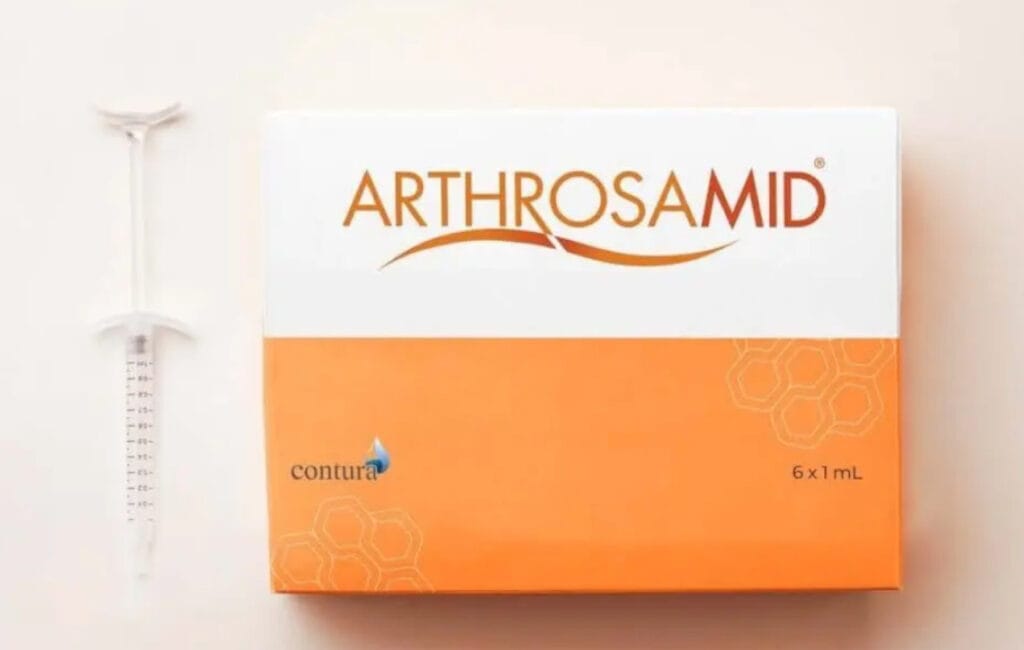
Arthrosamid is an ultrasound-guided injection for knee osteoarthritis. It is classed as a medical device rather than a drug, which means it has fewer potential systemic side effects than many medication-based treatments. It binds permanently to the capsule of the joint, helping to provide longer-term symptom relief. Most patients notice improvement within four to six weeks, and a positive response can often last between three and five years.
If you are living with knee osteoarthritis and weighing up your options, you want clear, honest answers before committing to any treatment.
Arthrosamid is one of the newer options we offer, and these are the questions our patients ask most often in clinic: how it works, what the day of the injection involves, how long the results last, and how it fits around other treatments.
Here are the answers, straight from our expert clinicians.
Key takeaways
- How it works: Arthrosamid is a gel that binds permanently to the joint capsule, which is why its relief lasts longer than a steroid, hyaluronic acid or platelet rich plasma (PRP).
- Results: Most patients begin to notice improvement within four to six weeks, although the true effect is usually best assessed at around 12 weeks. When successful, symptom relief commonly lasts between three and five years, and the treatment can be repeated if required.
- The procedure: It is an outpatient injection under ultrasound guidance with a large volume of local anaesthetic, so you walk in and walk out the same day.
- Surgery is still an option: Having Arthrosamid does not stop you having a partial or full knee replacement later if you need one.
- Access: In the UK it is currently self-pay, as insurers do not yet cover it, and it is not freely available on the NHS.
What is Arthrosamid and how does it work?
Arthrosamid is classed as a medical device. It is a gel that binds permanently to the capsule of the knee joint, which is why it gives longer-term lasting relief.
Rather than acting like a short-term medication, Arthrosamid integrates with the joint capsule once it is injected. That permanent binding is the reason a positive result can last for years rather than weeks.
It is licensed in the UK specifically for knee osteoarthritis, and not for the treatment of other joints. The injection itself is an outpatient procedure carried out under ultrasound guidance, and it is combined with a large volume of local anaesthetic that makes it well tolerated by patients.
- Classed as a medical device, not a drug.
- Binds permanently to the joint capsule for longer-term relief.
- Licensed in the UK for knee osteoarthritis only.
- Delivered under ultrasound guidance with plenty of local anaesthetic.
How quickly does Arthrosamid work and how long do results last?
Most people see improvement at around four to six weeks, with the truer test at 12 weeks.
Improvement is gradual rather than instant. Patients continue to improve beyond the first few weeks, particularly when they combine the injection with good quality rehabilitation.
In patients who get a positive result, Arthrosamid generally provides three to five years of reduced pain and improved function.
Once that benefit fades, the injection can be repeated.
- 4 to 6 weeks: most people start to notice improvement.
- 12 weeks: the truer test of how well it has worked.
- 3 to 5 years: typical duration of a positive result, after which it can be repeated.
What happens on the day of your Arthrosamid injection?
Arthrosamid is an outpatient procedure. Patients walk in and walk out on the same day, and the knee may be somewhat sore for a few days afterwards.
There is no need to rest the knee in the days leading up to the injection, so you can carry on as normal beforehand. After the injection, however, we do not recommend driving or cycling home.
You do not need to bring someone with you to your appointment, although you are welcome to do so if you would find it helpful.
In most cases, you can continue taking your regular medications as normal on the day of the injection.
As part of our screening process, we will review your medication and advise you of any specific changes that may be needed before your appointment.
- Walk in, walk out the same day, with the knee possibly sore for a few days after.
- No need to rest the knee beforehand.
- Do not drive or cycle home afterwards.
- Bringing someone is optional, your choice.
- Regular medication can usually continue, reviewed at your appointment.
Recovering and returning to activity after Arthrosamid
We recommend relative rest for the first two weeks, then a graded return to activity supported by focused physiotherapy.
Our recommendation is to return to normal everyday activities in the first two weeks. From there, we look for patients to have focused physiotherapy and a graded return to activity, starting with low-impact options such as cycling, rowing and swimming before progressing further.
Most people do not need to take pain relief medication after their injection. However, if you do get pain and swelling, we often recommend paracetamol, anti-inflammatories and ice, and we can bespoke any advice to you as part of your screening process and post-treatment protocol.
- First two weeks: relative rest and a return to normal everyday activities.
- Next: focused physiotherapy with a graded return to activity.
- Low impact first: cycling, rowing and swimming before higher-impact activity.
How does Arthrosamid compare to steroid injections and surgery?
A steroid injection is a short-term medication, whereas Arthrosamid is a longer-term injection that can last for many years.
Steroid injections reduce pain and swelling in the knee in the short term. Arthrosamid works differently, binding permanently to the joint capsule to provide relief that can last for years.
Importantly, choosing Arthrosamid does not close the door on surgery. If you find that it does not work for you, you can go on to have knee surgery, and having Arthrosamid does not stop you having a partial or total knee replacement.
It can also still be used in patients who have bone-on-bone arthritis, although the period for which it is effective may be less.
In short: a steroid is short-term relief; Arthrosamid aims for longer-term relief and keeps your future surgical options open.
Timing Arthrosamid around other knee treatments
We recommend leaving a gap between Arthrosamid and other injections: six weeks after a steroid, and three months after hyaluronic acid or PRP.
If you have recently had another injection in the knee, the timing matters. These are the gaps we recommend before having Arthrosamid.
| Previous treatment | Recommended gap before Arthrosamid |
|---|---|
| Steroid injection | 6 weeks |
| Hyaluronic acid injection | 3 months |
| PRP injection | 3 months |
Cost, insurance and NHS availability
Arthrosamid is currently only available as a self-pay patient in the UK, as insurers do not yet fully cover it. It is also not a treatment that is freely available within the NHS.
That said, there are studies in NHS groups across the country where Arthrosamid is being used, so availability may continue to evolve.
- Generally self-pay in private clinics.
- Not fully covered by UK insurers at present.
- Not freely available on the NHS, though used in some NHS study groups.
Privately in the UK, Arthrosamid typically costs between £2,500 and £3,000 per knee.
Prices vary between providers, and it is worth checking exactly what is included. Some advertised figures are facility or product charges only, and may not cover the initial consultation, the ultrasound assessment, or follow-up appointments.
Because Arthrosamid is a one-off treatment intended to last years, it is best considered against the cost of repeated shorter-acting injections over the same period.
At Complete Injections, an Arthrosamid injection costs £2,750, or £5,300 for both knees.
Every patient considering Arthrosamid at Complete Physio will first have a pre-injection telephone consultation with one of our expert clinicians (included in the price).
Arthrosamid FAQs
Can I have both knees injected with Arthrosamid on the same day?
Yes, you can have both knees injected on the same day, which is often the preferred option if you have travelled a long distance to see us in clinic. Otherwise, patients usually have their more severe knee treated first and come back at a later date to have the other knee treated.
Does the Arthrosamid injection hurt?
Arthrosamid is an outpatient procedure carried out under ultrasound guidance, and it comes with a large volume of local anaesthetic. This makes the injection well tolerated by patients. It is performed in clinic, and you walk in and walk out on the same day. Most clients report minimal pain during the procedure.
How soon will I feel the benefit of Arthrosamid?
Most patients begin to notice improvement within four to six weeks. However, the treatment is best assessed at around 12 weeks, and many people continue to improve beyond this point, particularly when the injection is combined with a structured rehabilitation programme.
Can I drive home after my Arthrosamid injection?
No. Following your Arthrosamid knee injection, we do not recommend driving or cycling home. You do not need to bring someone with you to your appointment, although you are welcome to do so if you would prefer. Many patients attend on their own, but bringing a friend or family member is entirely a personal choice.
Is Arthrosamid available on the NHS?
Arthrosamid is currently not freely available within the NHS. However, there are studies in NHS groups across the country where Arthrosamid is being used. In private clinics, the patients we see for Arthrosamid are generally self-pay.
Can I still have a knee replacement after Arthrosamid?
Yes. If you find that Arthrosamid does not work for you, you can go on to have knee surgery. Having Arthrosamid does not stop you having a partial or full knee replacement in the future. Depending on the surgeon and the surgical plan, they may recommend waiting three to six months after an injection before proceeding with surgery.
How long does Arthrosamid last?
In patients who respond well, Arthrosamid typically provides three to five years of reduced pain and improved function. After that, the injection can be repeated if needed. It is designed as a longer-term treatment, unlike a steroid injection, which often provides shorter-term relief.
Will I need painkillers after Arthrosamid?
Most people do not need to take pain relief medication after their injection. However, if you do get pain and swelling, we often recommend paracetamol, anti-inflammatories and ice. We can bespoke any advice to you as part of your screening process and post-treatment protocol.
Can I have Arthrosamid if I have bone-on-bone arthritis?
Yes. Arthrosamid can still be used in patients who have bone-on-bone arthritis. However, the period for which it is effective may be less than in patients with less advanced osteoarthritis.
Is Arthrosamid right for you?
Arthrosamid offers a longer-term option for knee osteoarthritis. It is a medical device that binds permanently to the joint capsule, it is delivered as a straightforward outpatient injection under ultrasound guidance, and a positive result typically lasts three to five years before it can be repeated. It also keeps your future options open, as it does not prevent a knee replacement later.
The best way to know if it suits your knee is a proper assessment with a clinician who can review your history and screen your suitability.
Ready to book or find out the cost?
Arthrosamid is available as a private treatment across our UK clinics. For full pricing information, including single and both-knees options, visit our Arthrosamid pricing page. To read the full clinical information including procedure details, consent information and case studies, visit our Arthrosamid knee injection service page.
Sources and further reading
- Arthrosamid by Contura, official product information
- National Institute for Health and Care Excellence (NICE), osteoarthritis guidance
- NHS, Osteoarthritis overview
- Complete Physio, Arthrosamid and ultrasound-guided injections service
Written by: Complete Physio Clinical Team, MSK and ultrasound-guided injection specialists.
Last updated: 9 July 2026
Note: This article is for general information and is based on our clinical guidance. It is not a substitute for an individual assessment. Suitability for Arthrosamid is determined as part of a screening process with your clinician.