
Arthrosamid Injections for Knee Osteoarthritis: How They Work, Cost & Results

Arthrosamid is a single injection for knee osteoarthritis. It's a polyacrylamide hydrogel - a CE-marked medical device, not a drug - given under ultrasound guidance. It integrates into the lining of the knee to reduce pain and swelling, with benefit building over the first weeks and sustained for up to three years in published clinical trials.
If steroid, hyaluronic acid, or PRP injections have stopped holding your knee pain at bay, but you're not ready, or not suitable for a knee replacement, Arthrosamid may be an option you haven't been offered.
It's relatively new to the UK and works quite differently from the injections most people have tried.
This guide explains what Arthrosamid is, how it works, who it suits, what the evidence actually shows, its cost and NHS status, and exactly what to expect before, during and after treatment.
Key takeaways
- One injection, lasting relief. Arthrosamid is a single, one-off treatment. Published trials show benefit is sustained for up to three years after one injection, with longer-term data emerging.
- Built for moderate knee osteoarthritis - often when steroid, hyaluronic acid or PRP are no longer helping, but you're not ready for surgery.
- A medical device, not a drug. It works with your body's own biology, stays exactly where it's placed, and has no whole-body (systemic) effect.
- Rehab is part of the treatment. Results build over weeks to months, and structured physiotherapy improves the outcome.
- Private, not routine NHS. Arthrosamid is available privately in the UK (typically around £2,500–£3,000 per knee); it isn't routinely funded by the NHS.
What is Arthrosamid?
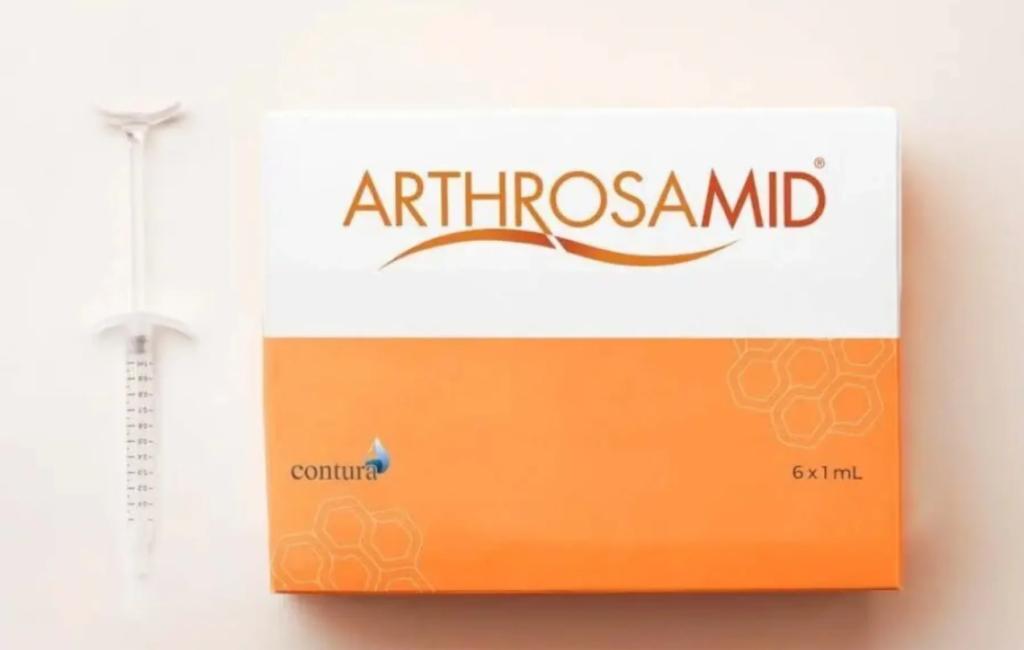
Arthrosamid is an inert hydrogel injection for knee osteoarthritis, made of 2.5% polyacrylamide and 97.5% non-pyrogenic (sterile) water. It is classed as a medical device - not a drug.
It was developed in Denmark by the manufacturer Contura, received its European CE mark in 2021, and launched in the UK in September 2021. Before that, UK patients sometimes travelled to Denmark to have it.
Because it is a device rather than a prescription medicine, it doesn't act on the body the way a steroid does, and it is non-biodegradable, meaning it stays in the joint long term rather than being absorbed.
It’s delivered as a single injection directly into the knee under ultrasound guidance, so it goes precisely where it's needed.
Arthrosamid is currently only licensed for treatment of knee osteoarthritis only. It’s not yet licensed for other joints such as the hip, shoulder or ankle.
How does Arthrosamid work?
Dr George Bownes, Sports Doctor at Complete Physio explains:
"Unlike steroid, hyaluronic acid and PRP, which are naturally processed by the body over time, Arthrosamid integrates into the joint lining and remains in place, contributing to its long duration of action."
Once injected, the hydrogel integrates with the synovium (the thin membrane that lines the knee joint) and is closely involved in inflammation.
Peer-reviewed studies describe the gel as non-absorbable, non-biodegradable and non-migratory; it forms a scaffold within the lining rather than dispersing.
Synovial biopsy studies in treated knees show the body's own cells growing into the gel to create a new, healthier lining layer, with the integrated gel still in place years later. A healthy synovium produces a better amount of joint fluid, which keeps the joint moving smoothly, helps reduce swelling and inflammation in the surrounding tissues, and therefore reduces pain.
Because this is a biological process rather than a simple top-up of joint fluid, the benefit builds over weeks rather than appearing overnight.
Who is Arthrosamid for?
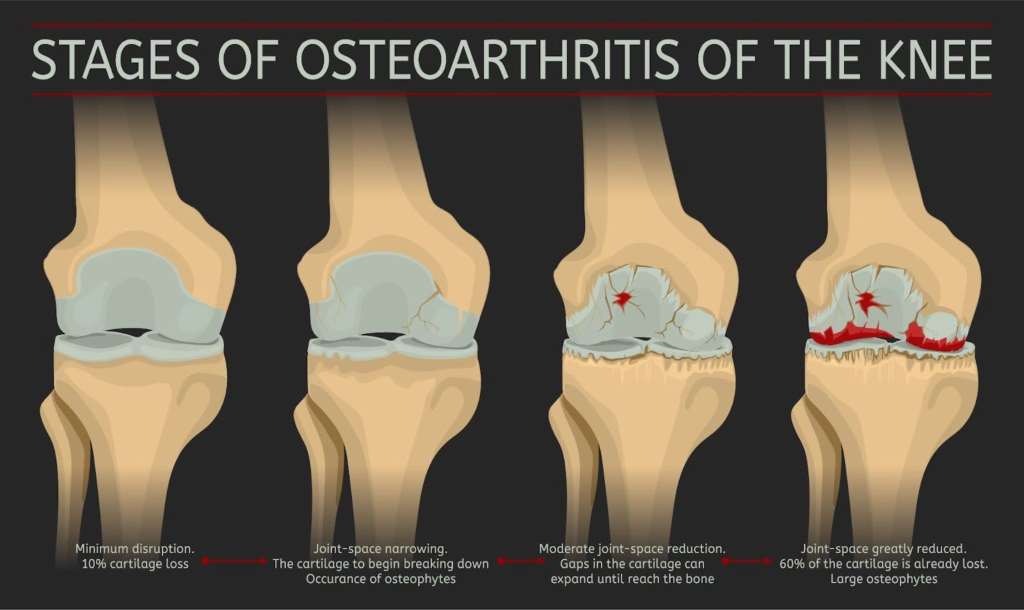
Arthrosamid is best suited to people with mild-to-moderate/ early advanced, knee osteoarthritis; typically relatively active individuals with ongoing pain and some swelling, who are not ready or not suitable for surgery.
A Typical Arthrosamid Patient
A patient in his late 60s came to clinic because knee pain was starting to affect the activities he enjoyed most.
He was still active and continued to play tennis and golf several times a week - although this was becoming increasingly difficult and more painful.
However, he was finding that his knee was becoming increasingly limiting. He was avoiding longer matches, struggling with quick changes of direction, and often experiencing significant pain and stiffness afterwards.
He explained:
"I can still play golf, but with tennis, I’m having to pick and choose when I get on court, and I'm in pain for a day or two after a match or a morning out on the course."
He had had some physiotherapy, which had helped at first, and had been fairly consistent with his exercise programme. He had also received a couple of steroid injections, which provided some relief, but the benefits were short-lived.
He had been advised that knee replacement surgery might eventually be an option. However, he felt that his symptoms were not yet severe enough to justify surgery and wanted to remain active for as long as possible without taking that step.
“This is often the stage at which treatments such as Arthrosamid are considered” explains Dr. Bownes
It can also be a particularly sensible choice for people who can't easily have surgery, for example people with heart, cardiovascular or breathing conditions, or those for whom the systemic effect of a steroid isn't ideal.
In our clinicians' experience it can help across a wide range of patients, from people in their 40s with pain behind the kneecap, to people in their 50s and 60s with wear on the inner side of the knee, through to older, less active people in their 70s and 80s who simply want to keep walking, gardening, and maintaining independence.
You don't have to be sporty to benefit. It can also be used to "buy time" and build strength before a planned knee replacement, so the surgical result is better when the time comes.
Arthrosamid vs steroid, hyaluronic acid and PRP injections
The key difference is where each injection acts and how long it lasts: steroid, hyaluronic acid and PRP sit in the joint fluid and gradually wear off, whereas Arthrosamid integrates into the joint lining and lasts for years
| Injection | How it works | Typical duration | Best suited to |
|---|---|---|---|
| Steroid (cortisone) | Settles inflammation within the joint; fast-acting and often first-line. Has a systemic effect, so isn't right for everyone. | Variable - Around 3 - 6 months | Fast, short-term relief and flare-ups |
| Hyaluronic acid | Supplements the joint's natural lubrication; sits within the joint fluid. | Around 9–12 months | Early, mild-to-moderate osteoarthritis |
| PRP | Uses a concentrate of your own platelets to modulate the joint; sits within the joint fluid. | Around 9–12 months | Early, mild-to-moderate osteoarthritis |
| Arthrosamid | Integrates into the joint lining (an implant) and helps the synovium become healthier. | Up to 3 years in published trials (longer data emerging) | Moderate osteoarthritis, often when other injections no longer help |
How long does Arthrosamid last, and when will I feel it?
Most people begin to notice improvement between 2 and 12 weeks after the injection, with the average patient reporting benefits within 4–6 weeks.
Published clinical studies have demonstrated sustained pain relief for up to three years following a single injection, with longer-term follow-up data continuing to emerge.
Because the gel has to integrate with the joint, it doesn't work instantly. In studies, significant pain reduction is typically seen by around the three-month mark; in our clinicians' experience many people notice improvement from around four to six weeks, which then continues to build.
Rather than the "rise-then-fade" pattern of many injectables, Arthrosamid's effect tends to hold over time. The published evidence currently suggests people report benefit for at least three years after one injection.
Data presented at a 2025 conference, at four-year follow-up, and five-year efficacy and ten-year safety, suggest the effect can last considerably longer than 3 years, though those longer-term findings are still emerging and not all yet peer-reviewed.
To track progress objectively, our clinicians record baseline pain and function at the time of the injection and again at 3, 6, 9 and 12 months, using validated questionnaires alongside activity data.
What does the evidence say? Clinical trials and success rates
Arthrosamid is supported by published clinical trials showing meaningful, durable improvements in knee pain and function - though it is a newer treatment and the evidence base is still growing.
- 12-month study and "success rate". An open-label study reported significant, sustained improvements in pain and function over 12 months, with around 62% of patients classed as treatment responders. (Full text.)
- Three-year follow-up. Longer-term follow-up of trial patients reported pain relief sustained to three years after a single injection. (Read the follow-up data.)
- Randomised controlled trial (vs hyaluronic acid). A trial of 239 patients published in Clinical and Experimental Rheumatology compared Arthrosamid against hyaluronic acid and concluded it was at least as effective and as safe, with relief maintained for at least a year after a single injection. (Read the study.)
It's worth being clear: Arthrosamid is a CE-marked medical device, but it is not FDA-approved in the United States (where trials are ongoing), and NICE reviewed it as a possible topic and decided not to develop formal guidance at this stage, citing insufficient evidence.
That doesn't mean it doesn't work - the trial results are very encouraging - but it does mean the long-term evidence is still maturing, which is exactly why we measure and follow up every patient closely.
Is Arthrosamid available on the NHS?
No, currently Arthrosamid is not routinely available on the NHS. It is licensed and available in the UK, but it is generally offered privately.
Because NICE has not issued formal guidance recommending it (see above), it isn't part of standard NHS osteoarthritis treatment pathways, which focus on exercise, weight management, pain relief and, ultimately, joint replacement surgery. NHS-based research into Arthrosamid is ongoing — the Health Research Authority lists active studies — so its NHS status may evolve. For now, if you want Arthrosamid, it is accessed privately.
How much does Arthrosamid cost in the UK?
Privately in the UK, Arthrosamid typically costs in the region of £2,500–£3,000 per knee, with both knees often offered as a discounted package.
Prices vary between providers, and it's worth checking what's included: some advertised figures are facility or product charges only and may not cover the initial consultation, the ultrasound assessment, or follow-up appointments and rehabilitation. Because Arthrosamid is a one-off treatment intended to last years, it's best considered against the cost of repeated shorter-acting injections over the same period. At Complete Injections, an Arthrosamid injection costs £2,750 (both knees £5,300).
Every patient considering Arthrosamid at Complete Physio will first have a pre-injection telephone consultation with one of our expert clinicians (included in the price).
This allows us to assess whether Arthrosamid is an appropriate treatment option, review any relevant medical history and previous treatments, and discuss what to expect from the procedure and recovery process. It also provides an opportunity for patients to ask any questions they may have and ensure they feel fully informed before proceeding.
We believe this personalised approach adds significant value, helping patients make confident decisions about their care and ensuring that Arthrosamid is offered to those most likely to benefit from the treatment.
What happens during the Arthrosamid procedure?
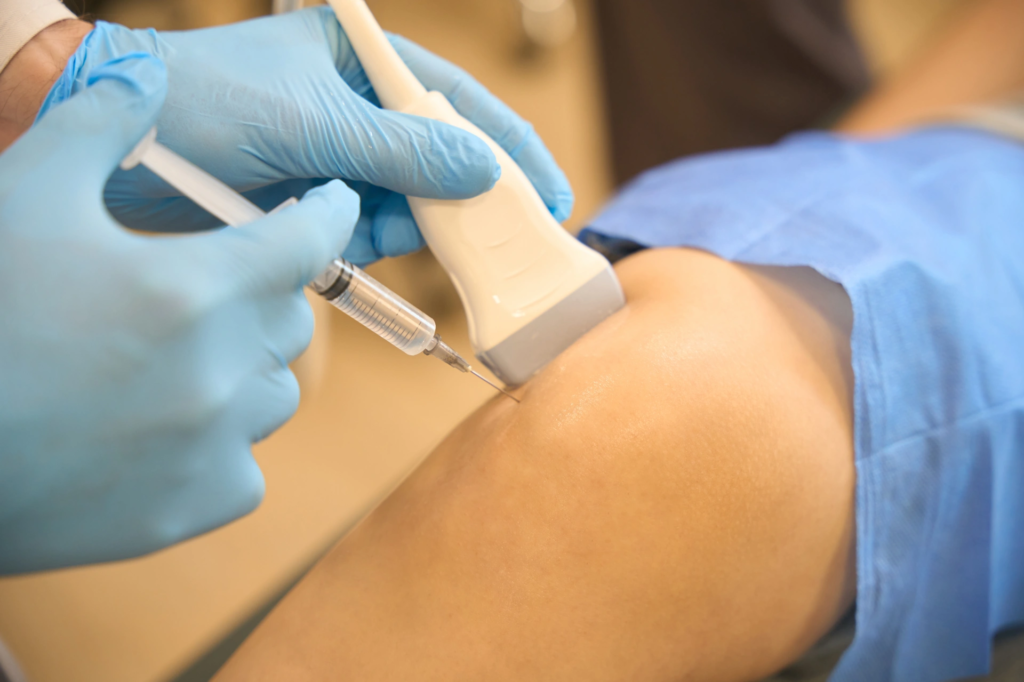
Arthrosamid is given as a single, ultrasound-guided injection in a short outpatient appointment, with plenty of local anaesthetic so the procedure itself is comfortable.
- Antibiotic first. Because Arthrosamid is an implant, it's treated like minor surgery, so a prophylactic antibiotic is taken shortly beforehand (commonly 1-2 hours before). Alternatives are available if you're allergic to penicillin.
- Baseline assessment. You complete pain and function questionnaires so your progress can be measured at later reviews.
- Ultrasound check. A painless scan lets the clinician assess any swelling and see the joint on screen.
- Draining first if needed. If there's significant fluid on the knee, it's drawn off first — which often eases pressure and feels better straight away.
- The injection. The skin is cleaned to a surgical standard, generous local anaesthetic is given, and the Arthrosamid (a single ~6ml dose) is delivered through a needle under ultrasound guidance, directly into the joint.
- Home the same day. A small plaster, and you walk in and walk out — though we ask you not to drive on the day of the injection.
People are very often surprised by how comfortable it is - thanks to the local anaesthetic, the knee usually feels good on the day.
Recovery, side effects and aftercare
Expect your knee to feel good on the day, then possibly stiff or swollen the next day.
The first two weeks are about returning to normal everyday activity, with structured physiotherapy advised at around two weeks.
Because Arthrosamid is an implant and the biology takes time, recovery is different from a quick steroid jab, you won't be back to full activity in 48 hours.
A realistic recovery picture:
- Day of injection: the knee usually feels good (local anaesthetic).
- Next day to two weeks: it may feel stiff or mildly swollen. Return to normal activity (in and out of a car, stairs) and gentle, low-impact movement such as static cycling, Pilates or yoga if you already do them. No brace, no crutches, no compression.
- From two weeks: rehabilitation begins in earnest — often weekly physiotherapy from weeks two to six, progressing by reaching objective milestones rather than fixed dates, and generally continuing to around three months. Ideally see a physiotherapist familiar with recovery after Arthrosamid.
Side effects following Arthrosamid injection
Arthrosamid has a strong safety profile, with published studies showing that side effects are generally mild and temporary.
In a well regarded clinical trial, approximately 29% of patients treated with Arthrosamid reported a treatment-related side effect, compared with around 8% of patients receiving hyaluronic acid injections.
The most commonly reported side effects included:
- Temporary swelling around the knee
- Mild discomfort or pain at the injection site
- Bruising
- A feeling of fullness or pressure within the joint
Importantly, no serious device-related adverse events were reported in the study.
In our clinicians' experience, temporary swelling is the most common side effect.
This is usually short-lived and settles with simple measures such as:
- Rest
- Ice application
- Elevation
- Paracetamol for pain relief
- Anti-inflammatory medication if appropriate and safe for you (ideally with stomach protection)
If swelling does occur, it is typically a normal response to the Arthrosamid implant rather than a sign of infection.
As with any injection into a joint, the most serious potential complication is infection, although this is rare.
To minimise this risk, we follow strict aseptic techniques and comprehensive infection-control protocols throughout the injection procedure.
Who should not have Arthrosamid?
Arthrosamid isn't suitable for everyone. It's not recommended for inflammatory or rheumatological joint conditions, and it's licensed for the knee only.
It is generally not appropriate if you have:
- an inflammatory arthritis such as rheumatoid arthritis, psoriatic arthritis or gout;
- an active infection in or around the knee;
- a previous knee replacement or other implant/foreign material in the joint;
- a bleeding disorder such as haemophilia, or uncontrolled blood-thinning treatment;
- had knee keyhole surgery (arthroscopy) within roughly the past six months;
- pregnancy or breastfeeding, or are under 18;
- a known sensitivity to polyacrylamide.
It's not suitable for other joints such as the hip, shoulder or ankle (those are being researched in Denmark, but Arthrosamid is currently a knee treatment only). If one of these applies to you, an assessment can identify a more suitable option.
Can you treat both knees, or repeat the injection?
Yes, both knees can be treated, either in the same appointment (with a separate, single-use needle for each) or one at a time, often the worse knee first.
Arthrosamid is designed as a one-off treatment, but because it lasts years it can be repeated in future if needed.
Some people prefer to treat the worse knee, see the benefit, then return a few months later for the other side. Because relief typically lasts several years, repeat treatments tend to come up only after a number of years, and often in people who load one knee heavily.
At Complete Injections, Arthrosamid injections for both knees costs £5,300 (£2,750 for single knee).
Can you treat both knees, or repeat the injection?
Yes, both knees can be treated, either in the same appointment (with a separate, single-use needle for each) or one at a time, often the worse knee first.
Arthrosamid is designed as a one-off treatment, but because it lasts years it can be repeated in future if needed.
Some people prefer to treat the worse knee, see the benefit, then return a few months later for the other side. Because relief typically lasts several years, repeat treatments tend to come up only after a number of years, and often in people who load one knee heavily.
At Complete Injections, Arthrosamid injections for both knees costs £5,300 (£2,750 for single knee).
Frequently asked questions
Does the Arthrosamid injection hurt?
Most people are pleasantly surprised that it isn’t particularly painful.
Plenty of local anaesthetic, similar to the dentist, is used before the single injection, so the procedure itself is essentially painless.
The knee can feel a little stiff or swollen the next day, but it shouldn't be very painful.
Is Arthrosamid a drug?
No. Arthrosamid is classed as a medical device, not a medication.
It's an inert polyacrylamide hydrogel that stays where it's injected, with no whole-body (systemic) effect and fewer side effects than a drug such as a steroid.
How long does Arthrosamid last?
Published trials show benefit from a single injection sustained for up to three years, with four-year and conference-presented longer-term data emerging.
Individual results vary, and engaging well with rehabilitation tends to improve and prolong the outcome.
How much does Arthrosamid cost, and is it on the NHS?
Privately in the UK it typically costs around £2,000–£3,000 per knee. It is not routinely funded on the NHS, so it's generally accessed privately.
What is the success rate of Arthrosamid?
In a published 12-month study, around 62% of patients were classed as treatment responders, with significant improvements in pain and function.
Results depend on the individual and on engaging with rehabilitation.
Are there side effects?
Side effects are usually mild and temporary, most commonly injection-site swelling, discomfort, bruising or a feeling of fullness.
In a highly regarded trial no serious device-related events were reported.
The main rare risk of any joint injection is infection, which the pre-procedure antibiotic helps prevent.
Why do I need an antibiotic beforehand?
Because Arthrosamid is an implant, it's treated like minor surgery.
A single prophylactic antibiotic, usually taken 1-2 hours before, is given as a precaution against infection alongside thorough, surgical-grade skin cleaning.
How soon will it work, and can I drive home?
Most people start to feel improvement between weeks 2 and 12, often from around four to six weeks.
You can walk in and walk out, but we ask you not to drive on the day of the injection, so plan your travel.
Can I take painkillers after the injection?
Yes. You can continue to take any painkillers or medications that you would normally use, unless you have been specifically advised otherwise by your doctor or healthcare professional.
Some patients experience discomfort, stiffness or swelling following the injection. This can last for many weeks, although the duration and severity vary considerably between individuals. If you have any concerns following your injection, please contact the clinic for advice.
Do I need to use crutches after the injection?
No. Patients do not normally require crutches or walking aids after the injection (unless you were already using them before the injection).
The local anaesthetic used during the procedure does not cause muscle weakness or affect your ability to control the leg, so you will be able to walk out of the clinic immediately afterwards.
We do, however, recommend avoiding high-impact activities, running and strenuous exercise for the first two weeks following the injection to allow the treatment to settle and integrate within the joint.
Can I have Arthrosamid in my hip or other joints?
Not currently, Arthrosamid is licensed for the knee only. Other joints are being researched, but for now it's a knee treatment, and we can advise on alternatives for other joints.
Is Arthrosamid right for your knee?
The best way to find out is a face-to-face assessment: a look at your knee, a review of any imaging, and a treatment and rehabilitation plan built around your goals.
Our specialist clinicians were among the first in the UK to offer Arthrosamid and follow up every patient with objective measures.
Learn more about our Arthrosamid service → | Book an assessment
Sources & references
- Bliddal, Henning et al. “Polyacrylamide gel versus hyaluronic acid for the treatment of knee osteoarthritis: a randomised controlled study.” Clinical and experimental rheumatology vol. 42,9 (2024): 1729-1735.
- Bliddal H, Beier J, Hartkopp A, Conaghan PG, Henriksen M. Effectiveness and safety of polyacrylamide hydrogel injection for knee osteoarthritis: results from a 12-month follow up of an open-label study. J Orthop Surg Res. 2024 May 2;19(1):274.
- Bliddal, Henning et al. “Three-year follow-up from a randomised controlled trial of a single intra-articular polyacrylamide hydrogel injection in subjects with knee osteoarthritis.” Clinical and experimental rheumatology vol. 44,5 (2026): 996-1003.
- NHS - Osteoarthritis (overview and treatment). nhs.uk
- Arthrosamid / Contura (manufacturer). arthrosamid.com
Related reading: Everything you need to know about Arthrosamid (2026) — full FAQ guide covering recovery, timing and comparisons. Arthrosamid knee injection service page — procedure details, consent and case studies. View Arthrosamid pricing.